Editorial review: August 2, 2026. Immigration details were checked against Paraguay’s national migration authority, and destination information against official tourism and UNESCO sources.
Paraguay is the country many South America itineraries leave in the blank space between Brazil, Argentina and Bolivia. That is precisely why it can be rewarding. Asuncion feels lived-in rather than staged, the Jesuit missions are among the continent’s most important historic sites, and the Chaco opens a landscape far removed from the familiar Andes-and-beaches circuit.
A first trip works best when it is focused. Spend time in the capital, choose one southern base, and add the Chaco only if you have enough days for its distances. This Paraguay travel guide builds a realistic route and explains the entry, transport and planning details that tend to be overlooked.
Prefer Arabic? Read our complete Paraguay guide in Arabic.
Paraguay at a glance
- Capital: Asuncion
- Languages: Spanish and Guarani are both official and widely present in daily life.
- Currency: Paraguayan guarani (PYG)
- Best first-trip length: 7 to 10 days
- Best route for most visitors: Asuncion, Encarnacion and the Jesuit missions
- Add the Chaco when: you have at least three extra days and are comfortable with long overland travel
Why visit Paraguay?
Paraguay is not a checklist destination. Its appeal lies in the texture between sights: terere shared in a plaza, Guarani heard alongside Spanish, family-run restaurants, riverfront evenings and long roads through red-soil countryside. Prices can be gentler than in better-known neighbors, although imported goods and remote transport are not necessarily cheap.
The country also rewards travelers interested in history. The ruins of La Santisima Trinidad de Parana and Jesus de Tavarangue form Paraguay’s UNESCO-listed Jesuit Missions. They preserve an ambitious chapter of the Jesuit reductions, communities where European and Guarani traditions met under a complicated colonial system.
Nature is a different proposition. Eastern Paraguay is greener and more populated; the Gran Chaco in the west is vast, hot and sparsely settled. It is rich in wildlife and cultural history, but distances and limited services mean it should be planned as a deliberate second leg, not squeezed into an afternoon.
Entry requirements for Paraguay
Requirements depend on nationality. Paraguay’s migration authority asks foreign visitors for a valid passport or another accepted travel document; eligible MERCOSUR nationals may use a recognized identity document. A visa is required for nationalities that are not exempt.
The authority states that every entry and exit must be registered and that temporary visitors can be admitted for up to 90 days, with one extension possible through the immigration process. The period actually granted and your eligibility for an extension remain official decisions.
Before departure:
- Check the current entry requirements from Migraciones Paraguay.
- Confirm visa status with the Paraguayan consulate responsible for your residence if the official list is not clear.
- Carry onward or return plans, accommodation details and evidence of funds even when they are not requested at every arrival.
- Make sure your entry is recorded and keep the entry receipt or stamp safely.
Do not cross at an informal point because it looks convenient on a map. An unregistered entry can create problems when leaving, extending a stay or visiting another country.
Best places to visit in Paraguay
Asuncion
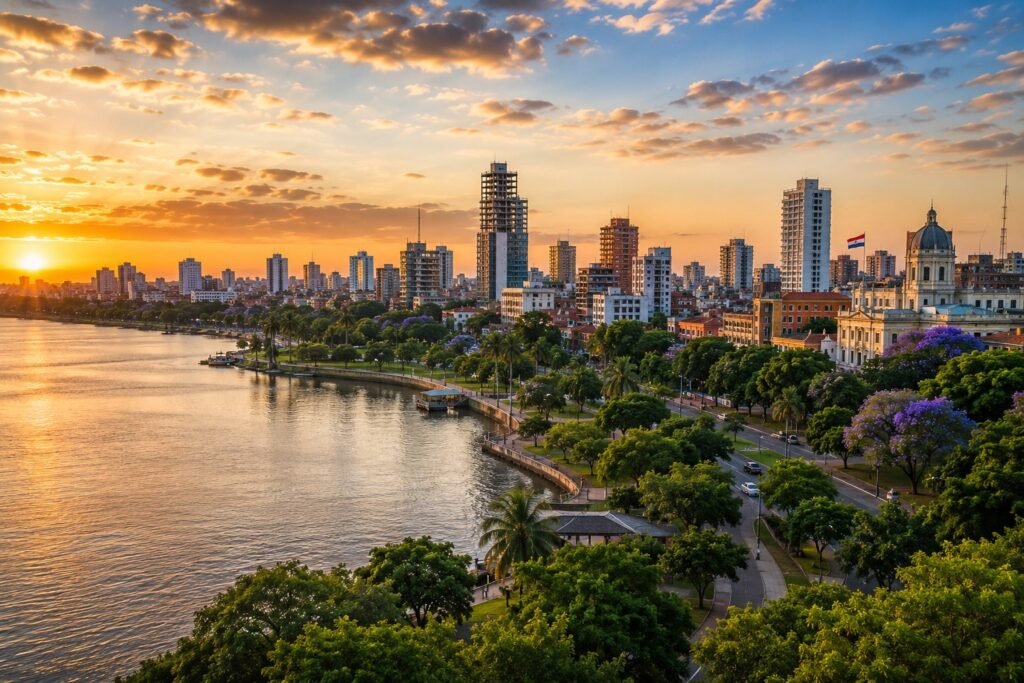
Asuncion deserves two full days, not only a night between buses. Begin around the historic center with the Palacio de los Lopez exterior, the National Pantheon of the Heroes, Casa de la Independencia and the cultural spaces near the old port. The Costanera gives the city breathing room at sunset, while neighborhoods such as Villa Morra offer a more contemporary restaurant and cafe scene.
The center changes character block by block, and some streets become quiet outside business hours. Use normal city awareness, ask your accommodation about the current walking route and take a registered taxi or ride-hailing car when a journey feels awkward.
Encarnacion
Encarnacion is an easygoing southern base on the Parana River. Its waterfront, urban beach and evening promenade make a pleasant contrast to the capital. More importantly, it is well positioned for the Jesuit missions. Allow one day for the city and another for the archaeological sites rather than trying to race through both.
Trinidad and Jesus de Tavarangue
Trinidad is the more extensive complex, with a monumental church, carved stone and a layout that helps visitors imagine the scale of the settlement. Jesus de Tavarangue was never completed, but its surviving church structure is striking. Visiting both gives far more context than treating one ruin as a photo stop.
UNESCO lists the two missions as a single World Heritage property. Opening times and transport arrangements can change, so confirm locally the day before. A guide is valuable here because the most interesting story is not visible from the masonry alone.
Ciudad del Este and Monday Falls
Ciudad del Este is one of South America’s busiest border-commercial cities. Some travelers enjoy its intensity; others use it as a gateway. Nearby Saltos del Monday provides a powerful waterfall experience, while the Itaipu area adds engineering and regional history. If Iguazu Falls is also on your journey, compare border time and onward connections before deciding where to sleep.
The Gran Chaco
Filadelfia is the practical starting point for learning about the central Chaco, Mennonite settlement and local museums. Wildlife-focused trips go farther and require a capable operator, reliable transport, water and a plan for limited connectivity. The Chaco is most satisfying for travelers who accept that the road is part of the experience.
A realistic 8-day Paraguay itinerary
- Day 1: Arrive in Asuncion and take an unhurried Costanera walk.
- Day 2: Explore the historic center, museums and Paraguayan food.
- Day 3: Keep a flexible capital day for markets, galleries or a nearby excursion.
- Day 4: Travel to Encarnacion and spend the evening on the riverfront.
- Day 5: Visit Trinidad and Jesus de Tavarangue.
- Day 6: Enjoy Encarnacion or add a slower regional stop.
- Day 7: Return to Asuncion; avoid placing a tight international connection after a long bus journey.
- Day 8: Depart or continue overland to Argentina or Brazil.
For 10 to 12 days, add the Chaco with two nights around Filadelfia. Do not simply attach it to day seven: the west requires a separate transport plan and more buffer.
Getting around Paraguay
Long-distance buses connect the main cities and are the default for independent travelers. Quality varies, so ask about the vehicle, stops and arrival terminal rather than comparing price alone. Buy busy routes in advance around weekends and holidays.
Inside Asuncion and Encarnacion, buses are inexpensive but routes can be difficult to decode on a first visit. Ride-hailing services and registered taxis simplify evening journeys. For the missions, a rental car, private driver or organized excursion saves time; confirm insurance and border restrictions before taking a rental into a neighboring country.
Distances that look modest can take longer than expected. Roadworks, heat, local traffic and indirect routes make a two-hour buffer more useful than an overpacked day.
Food, money and daily travel
Try sopa paraguaya, which is a dense corn-and-cheese bread rather than soup; chipa, made with starch and cheese; mbeju; grilled meats; and vori vori, a comforting broth with cornmeal-and-cheese dumplings. Terere, cold yerba mate prepared with water and often herbs, is part of social life rather than a novelty drink.
Cards are common in hotels, supermarkets and many urban restaurants, but cash remains useful for markets, small buses and rural stops. Withdraw from a bank-affiliated ATM, decline unhelpful dynamic currency conversion when offered, and carry smaller notes. Do not rely on one card.
Spanish unlocks most travel situations. Even a few Guarani greetings are warmly received, but use them with humility; Paraguay’s bilingual culture is living and complex, not a performance for visitors.
When to visit and what to pack
Paraguayan summers are hot and can be intensely humid. The cooler months are generally easier for city walking and overland travel, while cold fronts can still make mornings surprisingly fresh. Rain is possible throughout the year, and unpaved access in remote areas can change after storms.
Pack breathable clothing, sun protection, insect repellent, a reusable bottle, a light rain layer and one warmer layer. For the Chaco, add more water capacity, offline maps and a power bank. Ask a travel-health professional about your itinerary well before departure, particularly if it includes remote or tropical areas.
Safety and common planning mistakes
Most visits are straightforward, but the same habits that matter across the region apply: keep phones unobtrusive near traffic, use trusted transport at night, leave the passport secured when a copy is sufficient, and separate cards and emergency cash. At borders and bus terminals, ignore unsolicited helpers who want to take your documents.
Avoid these first-trip errors:
- Treating Asuncion only as an arrival terminal.
- Trying to combine the missions, Ciudad del Este and the Chaco in a few days.
- Assuming every border crossing is open to foreign travelers at all hours.
- Failing to keep proof that immigration registered the entry.
- Expecting English to solve every transport conversation.
Frequently asked questions
How many days do I need in Paraguay?
Seven or eight days cover Asuncion, Encarnacion and the Jesuit missions at a comfortable pace. Ten to twelve days allow a meaningful Chaco extension or slower eastern route.
Is Paraguay worth visiting on a first South America trip?
Yes for travelers who value local rhythm, history and less-visited places. If your first trip is only one week and centered on iconic landscapes, choose a tighter country route and save Paraguay for a regional journey.
Do I need a car?
No for Asuncion and Encarnacion. A car or driver becomes useful for the missions and more remote areas, but long-distance buses can still anchor the main itinerary.
Can I combine Paraguay with Argentina or Brazil?
Yes. Paraguay fits naturally with northeastern Argentina and southern Brazil. Check each border’s opening hours, transport connections and entry rules independently before committing to the route.
Official planning sources
- Migraciones Paraguay: entry and exit requirements
- Visit Paraguay: Asuncion
- Visit Paraguay: Jesuit Route
- UNESCO: Jesuit Missions of La Santisima Trinidad de Parana and Jesus de Tavarangue
Continue planning with our Argentina travel guide, Brazil travel guide or comparison of the best places for a first South America trip.