Read the Arabic version of this Suriname guide
Last reviewed: August 2, 2026. Suriname feels different from the Spanish- and Portuguese-speaking routes that dominate South America. Paramaribo’s wooden architecture, Dutch language, Javanese and Hindustani food traditions, Maroon and Indigenous communities, rivers and rainforest produce a trip that does not resemble a smaller version of a neighboring country.
The right first itinerary is modest: understand Paramaribo, take one historical day trip, then enter the interior with an operator whose logistics are explicit.
Entry fee, eVisa and the ICF
Suriname uses an authorized online portal for the entry fee and eVisa. Which product applies depends on nationality and travel purpose. Start with the eligibility flow on the official Suriname eVisa and entry-fee portal; do not assume that a rule for another passport applies to yours.
The same official system states that the Immigration and Customs Form, or ICF, is mandatory and can be completed before travel, including within the three days before arrival according to its current instructions. Read the portal’s frequently asked questions, submit accurate passport details and keep every confirmation available offline.
Carry onward travel, the first accommodation address and any supporting documents requested for your category. An approved online document does not remove the border officer’s authority to assess entry.
A 9-day Suriname route
Days 1-3: Paramaribo
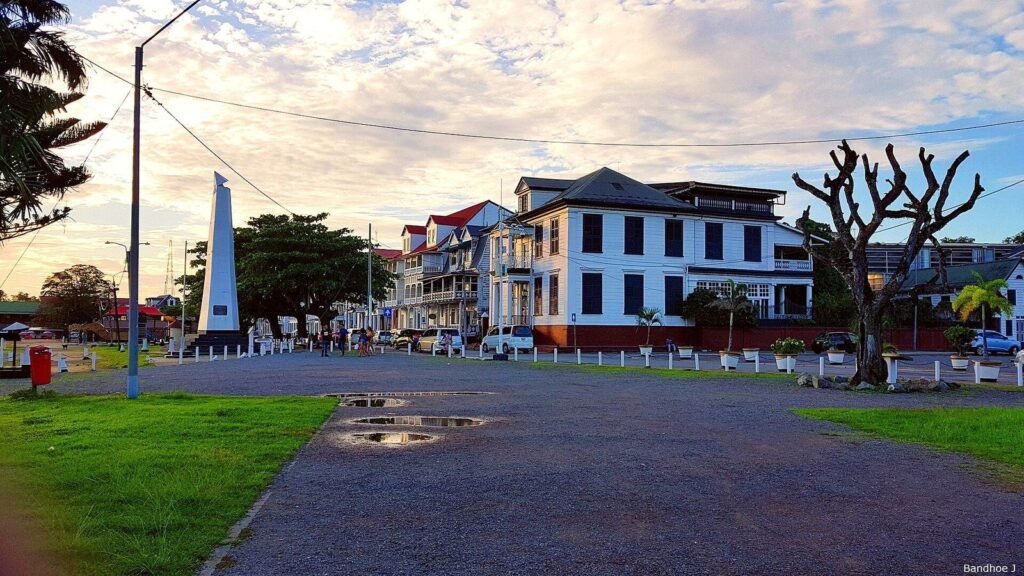
Begin around the historic inner city and Waterkant, but do not treat the wooden buildings as a quick photo circuit. UNESCO describes the Historic Inner City of Paramaribo as a distinctive fusion of European planning and local construction. A guided walk adds the history needed to read that mixture.
Use the second day for markets, religious architecture and food. A mosque and synagogue stand close together in the city, while menus reflect several migrations and communities. Ask before photographing people, religious activity or market stalls.
Keep the third day flexible for a museum, riverfront evening or practical preparations for the interior. Confirm cash needs, luggage limits, pickup and mosquito protection with the operator.
Days 4-5: Commewijne or Jodensavanne
Choose one historical excursion rather than collecting both at speed. Commewijne routes often explore former plantation landscapes and river communities. Jodensavanne adds a different chapter of settlement, religion and colonial history. The value lies in interpretation, including the realities of forced labor and slavery, not only the scenery.
UNESCO’s Suriname World Heritage overview lists Jodensavanne Archaeological Site alongside Paramaribo and the Central Suriname Nature Reserve. Check current access and transport before choosing the day.
Days 6-8: One interior stay
Select a lodge or community-based trip according to travel time and activity level. Some journeys use road and boat combinations; a place described as a few hundred kilometers away may consume most of a day. Ask for a written outline covering transport, meals, sleeping arrangements, electricity, communications, guides and the return contingency.
Community visits should not be sold as access to people on demand. Choose an operator that explains consent, local benefit, photography rules and appropriate behavior. Learn a little about the community before arrival and follow the host’s guidance.
In the forest, accept that wildlife is not scheduled. Quiet observation, insects, rain and river conditions are the experience. A responsible guide does not promise a specific animal encounter.
Day 9: Return buffer
Return to Paramaribo before an international departure day. River level, vehicle issues and weather can all change timing. Keep a city night between a remote lodge and a separate flight.
Language and communication
Dutch is the official language, while Sranan Tongo and several community languages are widely used. English may work in parts of the visitor economy, but it should not be assumed everywhere. Save addresses in writing and ask accommodation to confirm the best language for a driver or guide.
A few courteous words and patient communication matter. Suriname’s multilingual reality is part of the country, not a service obstacle.
Money and booking the interior
Ask hotels and operators which payment methods they currently accept. Carry a backup rather than depending on one foreign card. Exchange or withdraw money in established locations, count it discreetly, and avoid basing a budget on an unofficial rate found in an old post.
Interior packages can look expensive beside a city room because they may include boat transport, guides and meals. Compare inclusions line by line. A lower price that excludes the river transfer may not be lower at all.
Health and remote-travel preparation
Seek current medical advice for your route, vaccination history and time in forest areas. Requirements and recommendations can depend on where you arrive from as well as where you travel inside Suriname. Bring prescription medicine, sun protection, insect repellent and a dry system for documents and electronics.
Travel insurance should cover the activities and remote location. Ask how an operator communicates and evacuates in an emergency; “we have never needed it” is not an emergency plan.
Can Suriname be combined with Guyana or French Guiana?
Yes, but border transport is not a casual city-to-city bus assumption. River crossings, operating hours and onward vehicles require current confirmation. Build spare time into any overland Guianas itinerary and verify visa or entry rules for each territory separately.
For a different first South America framework, compare our South America destination guide and Brazil travel guide.
Frequently asked questions
Do I need a Suriname eVisa or entry fee?
It depends on nationality and purpose. Use the official portal’s eligibility process and do not purchase through an unverified intermediary.
What is the Suriname ICF?
It is the mandatory Immigration and Customs Form. Follow the timing and submission instructions on the official eVisa portal.
How long should I stay in Suriname?
Eight to ten days allow Paramaribo, one historical excursion and a short interior experience. A deeper rainforest journey deserves more time.
Can I visit the interior independently?
Some locations require specialized boat, road and community logistics. First-time visitors are usually better served by a reputable operator with clear inclusions and safety procedures.
Official planning links
- Official Suriname eVisa and entry-fee portal
- Official portal FAQ and ICF guidance
- UNESCO sites in Suriname
Featured image: Paramaribo Waterkant by Bandhoe Ch via Wikimedia Commons, CC BY-SA 4.0.